Why saddle type influences pad shape
A saddle pad needs an outline that works with its intended saddle. Jumping saddles commonly have forward-cut flaps, so their pads need suitable coverage toward the front. LeMieux describes its Close Contact Square as designed for forward-cut jumping saddles.
Dressage saddles typically have longer, straighter flaps. Their pads therefore often have a deeper profile. KM Elite describes its dressage square as designed to accommodate longer dressage saddle flaps.
Here, “deeper” means a greater drop from the topline to the lower edge. It does not mean a more concave topline. Likewise, a straighter front profile describes the outline beneath the saddle flap, not a requirement for a straight top edge.
These design considerations explain a general direction; they do not establish universal Cob dimensions or validate a particular specification.
A Cob size comparison
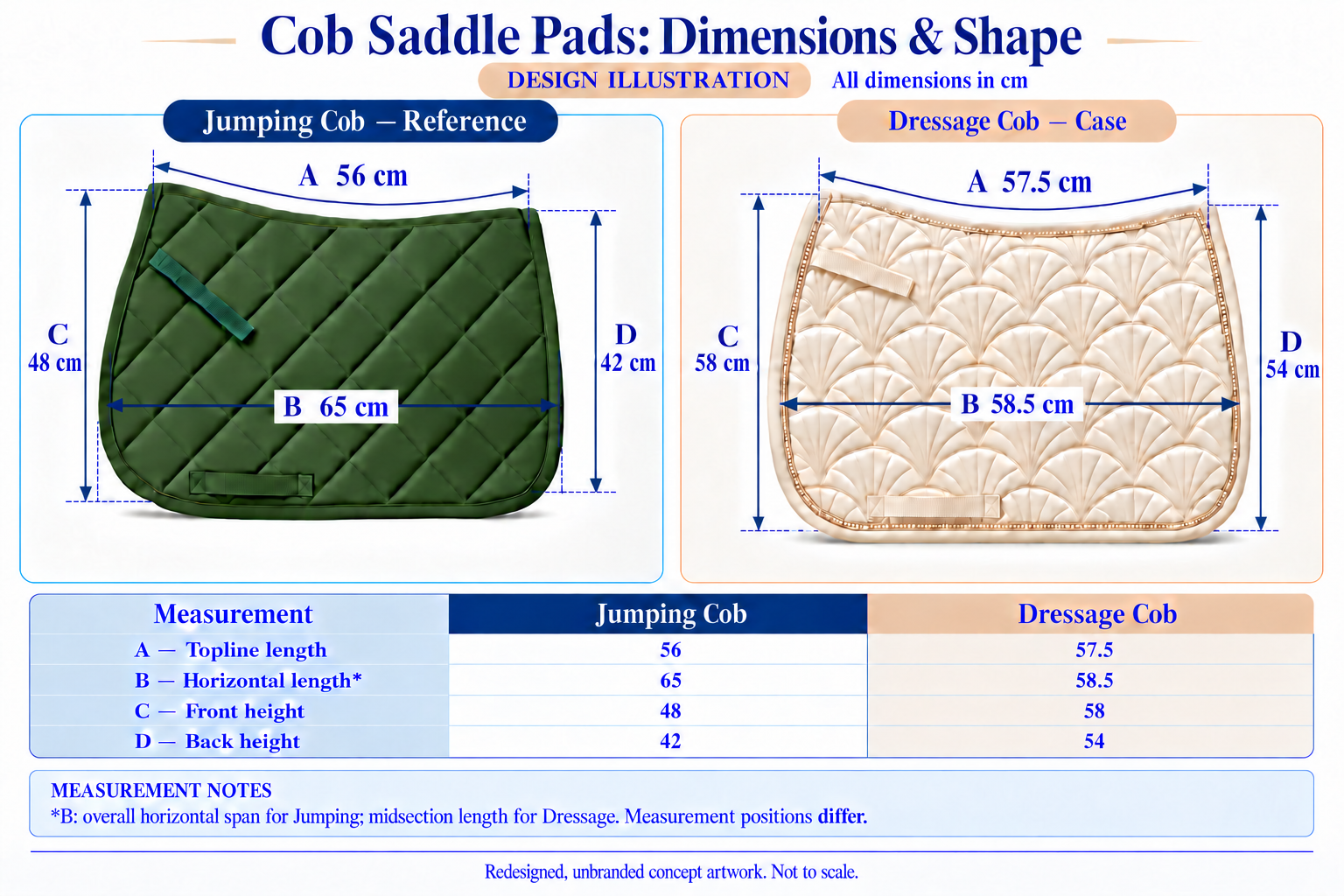
The following comparison uses the supplied dressage Cob case dimensions and jumping Cob reference dimensions. All values are shown in centimetres; the jumping values have been converted from inches and rounded to whole centimetres.
| Measurement | Jumping Cob | Dressage Cob |
|---|---|---|
| A — Topline length | 56 cm | 57.5 cm |
| B — Horizontal length* | 65 cm | 58.5 cm |
| C — Front height | 48 cm | 58 cm |
| D — Back height | 42 cm | 54 cm |
Design illustration. Redesigned, unbranded concept artwork; not to scale.
Measurement note: B represents the overall horizontal span in the jumping reference and the midsection length in the dressage reference. The illustration places both labels across the pads for readability; their measurement positions remain different. Do not treat the two B values as an identical measurement taken at the same location.
The dressage example has greater stated front and back heights, consistent with a deeper outline for longer flaps. The jumping reference has a more forward-projecting shape and a larger stated horizontal span, although the B measurement methods prevent a direct like-for-like difference calculation.
The table illustrates how two Cob references can differ. It does not establish which pad is more comfortable, more stable or a better fit for a particular horse and saddle.
Compare the measurement method, not just the numbers
Letters such as A, B, C and D only make sense with their measurement diagram. Before comparing products, check:
- Topline: Is it measured along the curve or directly between endpoints?
- Horizontal span: Does it represent the midsection or the maximum front-to-back extent?
- Depth: Is it a single-side drop or the full width of an opened pad?
- Edges: Are binding and external trims included?
- Condition: Are the dimensions for a finished, unwashed product, and is a tolerance specified?
For example, a fully opened width of 96 cm can correspond to about 48 cm per side at that measurement line, provided the pad is symmetrical and the line crosses the centre seam appropriately. It does not establish that both front and back heights are 48 cm.
What this means for saddle pad development
For a brand or buyer, “Cob Size” alone is an incomplete development brief. A usable specification should define the intended saddle type, relevant flap characteristics, pad outline, measurement points, finished dimensions, agreed tolerances, and fastening positions.
Gugoo supports equestrian brands and professional buyers with product development, sampling and OEM/ODM manufacturing. In a saddle pad project, a design illustration helps communicate the intended direction; the approved physical sample and agreed specification establish the production reference.
Changing quilting, binding or decorative details changes the visual design. The resulting product still needs to be made and checked before its dimensions and fit can be confirmed.
Choosing a pad beyond the Cob label
Start with the saddle type and outline it requires, then review the specific product’s size chart. An existing pad that works well with your saddle can provide a useful comparison if you measure it using the same method.
With a physical sample, check flap coverage, topline placement and whether fastening points align without excessive pulling. Seek advice from a qualified saddle fitter if fit is uncertain. A saddle pad should not be used to compensate for an incorrectly fitting saddle.
Cob identifies a size category. Dimensions, outline and measurement method explain the product within it.
Prepare your target market, intended saddle type, reference outline and measurement requirements. Gugoo works with equestrian brands, importers and retailers on saddle pads and other horsewear products.
Editorial note: This is an educational comparison, not an independent product test or fit certification. References to LeMieux and KM Elite identify sources for design explanations and do not imply affiliation or endorsement.
© 2026 Guangzhou Gugoo Pet Products Factory All rights reserved. This article may be linked to with attribution but may not be reproduced, translated, republished or used for commercial training without written permission.